
In today’s rapidly evolving digital landscape, businesses must go beyond traditional content analysis methods to stay competitive. Understanding the intricate relationships between different pieces of content on your website and how they connect to form a coherent narrative is vital. This is where Jazzb AI comes into play, offering a robust solution that combines web scraping with knowledge graph technology to analyze content across multiple pages—both online and offline—within a cluster of related topics.
What is a Knowledge Graph?
A knowledge graph is a powerful data structure that represents entities (such as people, organizations, and events) as nodes and their interconnections as relationships. This structure allows for the representation of complex, interrelated information in a way that is easily navigable and insightful.
In the context of content analysis, knowledge graphs provide a holistic view of how different pieces of information are related. For example, a knowledge graph can show how a university’s various departments, events, and administrative roles are interconnected to create a cohesive onboarding experience for new students.
Web Scraping and Content Clustering: The First Step
The first step in Jazzb AI’s comprehensive content analysis process involves web scraping and content clustering. Web scraping is the process of automatically extracting data from websites, allowing Jazzb AI to gather content from multiple web pages simultaneously. This can include everything from blog posts and product descriptions to user reviews and metadata.
Once the data is scraped, Jazzb AI clusters the content based on related topics, themes, or entities. This clustering is crucial for understanding how different pages within a website (or across multiple websites) contribute to a single, unified topic. For instance, when analyzing content related to a university’s orientation program, Jazzb AI can cluster pages about events, academic resources, and student services into a single group for deeper analysis.
Analyzing Content with Knowledge Graphs
After clustering, the next step is to map the scraped content onto a knowledge graph. This is where the true power of Jazzb AI’s solution comes into play. By defining nodes (entities) and relationships, Jazzb AI constructs a visual and analytical representation of how the content is structured.
Defining Nodes and Relationships
-
- Nodes: In a knowledge graph, nodes represent the core elements of your content. These could be people (e.g., university officials), organizations (e.g., student clubs), events (e.g., orientation sessions), or even abstract concepts (e.g., academic excellence).
-
- Relationships: The connections between nodes are known as relationships. These illustrate how the nodes interact with each other. For example, a “HAS ROLE” relationship could connect a person node to their role within the organization (e.g., a professor to their department), while a “PROMOTES EVENT” relationship might link a university official to a student event they are encouraging attendance at.
By defining these nodes and relationships, Jazzb AI can analyze how different pieces of content interact, providing insights that go beyond surface-level analysis. This helps in understanding the role each piece of content plays in the overall structure and how it contributes to achieving the website’s objectives.
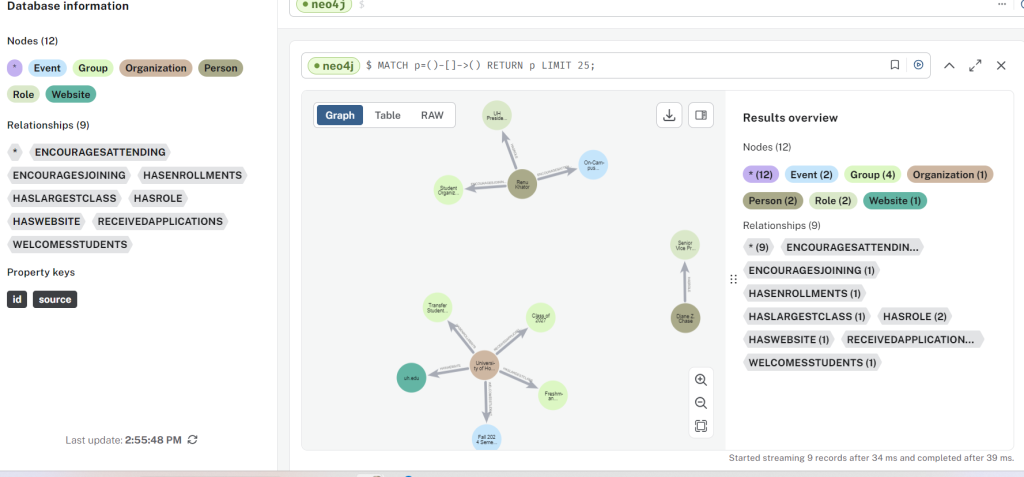
Case Study: University of Houston’s Freshman Welcome Content
Consider this webpage on Uinversity of Houston website for freshman. https://www.uh.edu/news-events/stories/2024/august/082024-largest-freshman-class-v2.phpLet’s consider a practical example to illustrate the process. Imagine the University of Houston’s website, where multiple pages are dedicated to welcoming new freshmen. These pages might include welcome messages from university officials, details about orientation events, and information about student organizations.
- Scraping and Clustering: Jazzb AI begins by scraping content from all relevant pages—such as those related to the university president’s welcome address, orientation schedules, and student club activities. These pages are then clustered into a single group under the theme “Freshman Welcome.”
- Knowledge Graph Construction: Next, Jazzb AI constructs a knowledge graph where nodes represent entities like the university president, the student organization, the orientation event, and the freshmen class. Relationships are then defined, such as “ENCOURAGES ATTENDING” between the president and the orientation event, or “HAS ROLE” connecting the president to the university.
- Analysis: With the knowledge graph in place, Jazzb AI can analyze how well the content is structured to welcome new students. For example, the analysis might reveal that certain key messages from the university president are not effectively connected to student resources or that important events are not prominently linked from the main welcome page.
Conclusion
In the digital age, simply having content on your website is not enough; understanding how that content works together to achieve your goals is crucial. Jazzb AI’s innovative solution leverages web scraping, content clustering, and knowledge graph technology to provide a comprehensive analysis of your content. By defining nodes and relationships, we help you see the bigger picture—identifying strengths, uncovering gaps, and ensuring that your content is as impactful as possible.
Whether you’re a university welcoming new students or a business looking to optimize your website’s effectiveness, Jazzb AI offers the tools you need to analyze, optimize, and succeed.